
By
Iñigo Vilella San Martín
R&D Industrial Engineer
Rethinking Wind Protection for Utility-Scale Solar Trackers
Why the future of solar tracker protection lies in understanding structural response rather than simply measuring wind speed.
For decades, wind has been one of the greatest engineering challenges facing utility-scale solar trackers. Every horizontal single-axis tracker is designed to maximise energy production while meeting demanding structural and operational requirements. Among these, maintaining structural safety under constantly changing wind conditions remains one of the industry’s most fundamental challenges.
Today, wind protection strategies are largely based on a simple principle: measure the wind speed, compare it against predefined thresholds and, when necessary, move the tracker into a safe position.
But this raises an important question. Is wind speed really the variable that determines whether a tracker is at risk? Or, put differently: Does the wind damage the tracker or does the way the tracker responds to the wind determine whether damage occurs? That distinction may seem subtle, yet it fundamentally changes how wind protection can be understood.
Measuring the wind… or understanding its effects?
At first glance, wind protection seems straightforward. Measure the wind speed, define a safe operating threshold and move the tracker into a stow position whenever that threshold is exceeded. This philosophy has protected utility-scale PV plants for decades and remains the industry standard today. However, wind speed alone does not describe what is actually happening inside the structure. According to the IEA PVPS, single-axis tracking systems are an increasingly important configuration in utility-scale photovoltaic plants.
In practice, a single anemometer often governs the protection strategy of an entire section of the plant. When predefined thresholds are exceeded, every associated tracker is commanded to move into a safe position regardless of its individual structural condition. This ensures safety, but it also means that many trackers may stop producing energy despite still operating with comfortable stability margins.
The reason is simple, imagine two trackers operating within the same solar plant during exactly the same wind event. Both experience similar wind speeds, yet one remains perfectly stable while the other approaches an unstable operating condition. Why? Because a tracker does not respond only to wind speed. Its behaviour is influenced by many other factors, including operating angle, wind direction, terrain, row-to-row shielding effects, wake effects, structural stiffness, damping and even changes accumulated throughout years of operation. As a result, neighbouring trackers may not even experience the same aerodynamic conditions, despite being part of the same wind event.
The wind is the external excitation. The structural response is what ultimately determines the level of risk. Measuring the environment tells us what the tracker is being exposed to. Understanding the structural response tells us how the tracker is actually behaving. Those are not necessarily the same thing.
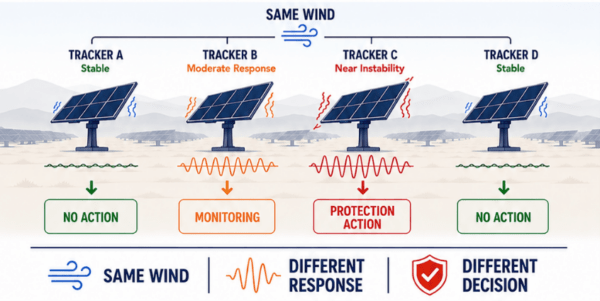
Figure 1. The same wind event does not necessarily produce the same structural response. Local conditions, tracker configuration and structural characteristics determine how each tracker behaves.
From measuring the environment to understanding the structure
If structural response is what ultimately determines structural risk, a natural question follows: Why are we still relying almost exclusively on environmental measurements to protect solar trackers? At IED, this question became the starting point for rethinking wind protection from first principles. Instead of asking: “How strong is the wind?” we asked a different question: “How is the tracker actually responding to the wind?” That simple shift in perspective became the foundation of TrueWind.
Rather than inferring structural risk from wind-speed measurements taken somewhere within the plant, TrueWind continuously evaluates the dynamic behaviour of each instrumented tracker directly where wind and structure interact. Running locally on an edge device installed on the tracker, the platform continuously estimates parameters such as tilt angle, torsional response, natural frequencies and damping ratios, transforming raw sensor data into meaningful engineering information.
Protection decisions are therefore based on the actual structural condition of the tracker rather than on environmental conditions alone. Instead of assuming risk from the environment, TrueWind evaluates risk directly from structural response. TrueWind transforms structural behaviour into actionable intelligence.
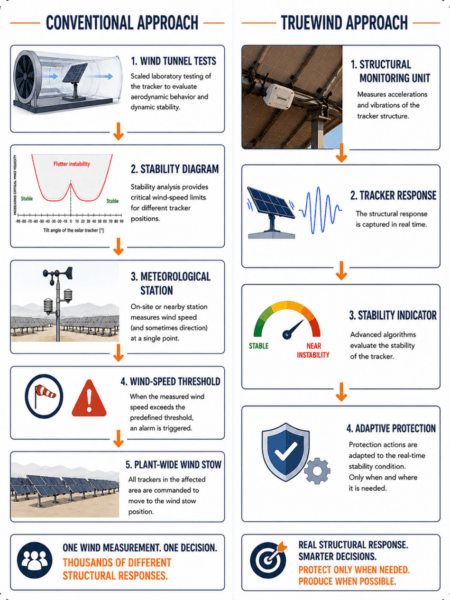
Figure 2. Conventional wind protection infers structural risk from environmental measurements. TrueWind evaluates structural behaviour directly, enabling selective protection decisions.
Better Information, Better Decisions
Understanding structural response is valuable because it enables better operational decisions. Every unnecessary wind stow reduces tracker availability, limits energy production and directly affects plant profitability. Conversely, every decision that delays protection beyond the actual structural limit increases mechanical risk. The challenge is therefore not choosing between production and protection but making better-informed decisions that optimise both.
By continuously evaluating the actual condition of each tracker, TrueWind enables protection strategies that are both safer and more selective. Trackers operating with comfortable stability margins can continue producing energy, while only those approaching critical conditions require protective actions. The objective is simple: Produce whenever it is safe to do so, and protect only when the structure truly requires it.
The result is a protection philosophy that improves availability, reduces unnecessary production losses and optimises the balance between structural safety and energy yield.
Digital Twin evaluations have demonstrated energy production improvements of over 3% under representative operating scenarios compared with conventional wind-speed-based strategies. While the exact benefit naturally depends on site characteristics, tracker design and wind conditions, these results demonstrate the potential of response-informed protection to recover energy that would otherwise be lost through unnecessarily conservative protection strategies.
TrueWind allows solar plants to remain productive for longer without compromising structural safety.
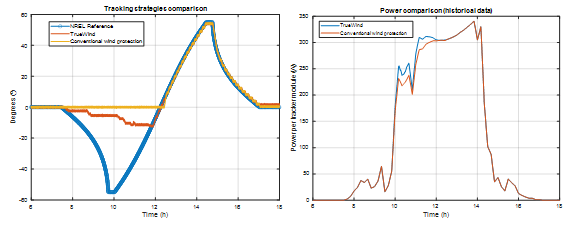
Figure 3. Digital Twin results comparing TrueWind vs Conventional approaches.
Building Confidence Through Engineering
Developing a new wind protection strategy requires more than innovative algorithms. It requires confidence that those algorithms accurately represent how trackers behave under real operating conditions. TrueWind has therefore been developed alongside a comprehensive engineering framework combining structural modelling, control simulation and dedicated field instrumentation.
At its core is a high-fidelity Digital Twin capable of reproducing the interaction between wind excitation, tracker structural dynamics and the complete control system. This environment allows engineers to evaluate protection strategies across thousands of operating scenarios before deployment.
Complementing this analytical framework, IED has also developed a dedicated field-validation platform designed to correlate simulated behaviour with real structural measurements, providing a robust engineering foundation for future deployment under real operating conditions.
Beyond Wind Protection
Wind protection is only the first application of TrueWind. The same structural information used to make protection decisions also provides continuous insight into the health of the tracker throughout its operational life.
Changes in damping, natural frequencies or vibration patterns can reveal loosening connections, foundation settlement, structural degradation or other evolving mechanical conditions long before visible failures appear.
By continuously transforming every instrumented tracker into a source of engineering information, TrueWind creates the foundation for predictive maintenance, fleet-wide structural benchmarking and long-term asset management. It is not simply a wind protection system. It is a platform for continuously understanding how solar trackers behave in the real world.
Rethinking Wind Protection
For decades, wind protection has been built around a simple idea: measure the wind and react when predefined thresholds are exceeded. That philosophy has successfully protected thousands of utility-scale PV plants around the world. However, as our understanding of tracker dynamics evolves, so too should the way we assess structural risk.
The wind itself does not determine whether a tracker is operating safely. It is the way the structure responds to that wind that ultimately defines its stability. Instead of asking only: “How strong is the wind?” we can now begin to ask: “How is the tracker responding to it?” That shift in perspective is the idea behind TrueWind.
By continuously transforming structural behaviour into actionable engineering information, TrueWind enables a new generation of protection strategies that are more selective, more adaptive and better aligned with the actual condition of each tracker.
As solar plants continue to evolve, we believe the future of wind protection will not be defined by measuring more environmental variables, but by better understanding the structures we are trying to protect. Every tracker experiences wind differently. Every tracker deserves to be protected accordingly.